post

Psychology in Quran / Psychological Defense Mechanisms

Question 584: Define Psychology in Quran? What kind of Psychological Defense Mechanisms have mentioned in the holy Quran?

Answer 584: We believe that the Holy Quran is a guidance and mercy for a people who have faith. The final purpose that the Holy Quran has been sent down for is to continuously nurture the human being to evolve it from a lower to a higher stage of existence. This means that the holy Quran nurture the human being unto perfection.

In the Holy Quran Allah, the Almighty says: “We have sent down the Book to you as a clarification of all things and as a guidance and mercy and good news for the Muslims”[1] The meaning of ‘All Things’ is every affairs that a human needs it to reach at the highest level of perfection. These affairs can be of the following: Material, Spiritual, Social and Individual aspects.

In psychology, ‘How to think’ is one of the things which is considered as the most important guidelines aspects of human life that has been explained completely in the Holy Quran.

According to Quran, there are three different kinds of characteristics can be imagined for the human beings: Momen (believer), Kafir (disbeliever) and Munafiq (hypocrite).[2]

A believer has the three following characteristics: Some of them are those who wrong themselves, and some of them are average, and some of them are those who take the lead in all the good works by Allah’s will.[3]

The characteristic by which we can recognize a Kafir is that they are deaf, dumb, and Blind; thus, they do not understand Anything, due to their shortage of Wisdom.[4]

What the tangible characteristic for the Munafiqs is that there is a sickness in their hearts and when they are told Do not cause corruption on the earth,” they say,” We are only reformers!  These are they who buy error for the right direction, so their bargain shall bring no gain, nor are they the followers of the right direction.  Their parable is like the parable of one who kindled a fire, but when it had illumined all around him, Allah took away their light, and left them in utter darkness they do not see.

The Quran has also talked about kinds of grief, sorrows and its solutions in order to get rid of it, two types of fears:

Acceptable fear:  “The faithful are only those whose hearts tremble] with awe [when Allah is mentioned, and when His signs are recited to them, they increase their faith, and who put their trust in their Lord”.[5]

Unacceptable Fear: “When they came at you from above and below you, and when the eyes rolled] with fear [and the hearts leapt to the throats, and you entertained misgivings about Allah; It was there that the faithful were tested and jolted with a severe agitation.”[6]
Kinds of anger in the holy Quran:

Useful rage: “As for him who endures patiently and forgives that is indeed the steadiest of courses.”[7]

Balanced rage: “Good and evil] conduct [are not equal. Repel] evil [with what is best.] If you do so, [behold, he between whom and you was enmity, will be as though he were a sympathetic friend.”[8]

Destructive rage: 1. “And hasten towards your Lord’s forgiveness and a paradise as vast as the heavens and the earth, prepared for the God wary”. [9] 2. “Certainly you were longing for death before you had encountered it. Then certainly you saw it, as you looked on”.[10]

The best solution when you are angry can be found in the following verses of the holy Quran:

  1. “Those who avoid major sins and indecencies, and forgive when angered”.[11]
  2. “Let the well-off and the opulent among you not vow not to give to the relatives and the needy, and to those who have migrated in the way of Allah, and let them excuse and forbear. Do you not love that Allah should forgive you? And Allah is all-forgiving, all-merciful”.[12]

In the Holy Quran there has been mentioned three kinds of Psychological Defense Mechanisms as follows:

Psychological projection: “There is certainly a good exemplar for you in Abraham and those who were with him, when they said to their own people,” Indeed we repudiate you and whatever you worship besides Allah. We disavow you, and between you and us there has appeared enmity and hate for ever, unless you come to have faith in Allah alone,” except for Abraham’s saying to his father,” I will surely plead forgiveness for you, though I cannot avail you anything against Allah.”” Our Lord! In You do we put our trust, and to You do we turn penitently, and toward You is the destination”.[13]

Rationalization (making excuses): ”When they are told,” Do not cause corruption on the earth,” they say,” We are only reformers!”; Look! They are themselves the agents of corruption, but they are not aware.”.[14]

Reaction formation:

  1. “Among the people is he whose talk about worldly life impresses you, and he holds Allah witness to what is in his heart, though he is the staunchest of enemies”; “And if he were to wield authority, he would try to cause corruption in the land, and to ruin the crop and the stock, and Allah does not like corruption”[15]
  2. “When you see them, their bodies impress you, and if they speak, you listen to their speech. Yet they are like dry logs set reclining] against a wall [. They suppose every cry is directed against them. They are the enemy, so beware of them. May Allah assail them, where do they stray?!”.[16]

Psychotherapy in Quran: One of the Useful Psychotherapy has been mentioned in the holy Quran is: “O mankind! There has certainly come to you an advice from your Lord, and a cure for what is in the breasts, and a guidance and mercy for the faithful.”[17]

In the Holy Quran Allah (SWT) introduces a Quranic Psychotherapy as follows: “Those who have faith and do not taint their faith with wrongdoing for such there shall be safety, and they are the [rightly] guided.[18]

Also, Allah, the Almighty introduces another Psychotherapy: “Those who have faith, and whose hearts find rest in the remembrance of Allah.” Look! The hearts find rest in Allah’s remembrance!”.[19]

Note: The previous mentioned verses are a few psychological examples have been explained in the Holy Quran.

For further information in this regards, please refer to the following answer:

Index: Good behavior? Refraining from a bad suspicion, answer 580.

[1] . Surah al-Nahl, verse 89.

[2] . Verses 2 to 20 of Surah Baqarah.

[3] . Surah Fatir, verse 32.

[4] . Surah Baqara, verse 171.

[5] . Surah Anfal, verse 2.

[6] . Surah Ahzab, verses 10 and 11.

[7] . Surah Shura, verse 43.

[8] . Surah Fussilat verse 34.

[9] . Surah al-Emran, verses 133.

[10] . Ibid, verse 143.

[11] . Surah Shura, verse 37.

[12] . Surah Noor, verse  22.

[13] . Surah Munafiqun, verse 4.

[14] . Sura Baqara, verses 11 and 12.

[15] . Surahs Baqarah, verses 204 and 205.

[16] . Surah Munafiqun, verse 4.

[17] . Surah Younes, verse 57.

[18] . Surah An’am, verse 82.

[19] . Surah al-Ra’d, verse 28.

post

Death of Asiya Bint Muzahim / Pharaoh ordered her be nailed to the floor

Question 528: Has Pharaoh stitched nails on fingers of his wife Hazrat Asiya Bint Muzahim and has he ordered to remove her skin before her death.

Answer 528:  When Asiya, Pharaoh’s wife, witnessed Moses’ miracle in front of the sorcerers, her heart was lit with the light of Iman (belief in the One God). She started to believe in Moses. She was trying to hide her faith from Pharaoh but faith and love of God is not something to be concealed. When Pharaoh learned about her faith, he forbade her times and again from believing in Moses; he pressured on her to give up his religion and abandon his God but she never surrendered herself to Pharaoh’s demand.

Finally, Pharaoh ordered his men to tie her up under the scorching sun and put a heavy stone on her chest and let her die there. Pharaoh ordered Asiya Bint Muzahim to be nailed to the floor. He put nails through her body to affix her to the floor under the scorching sun.

Again, the Pharaoh has ordered his courtiers to remove the skin of the queen. Due to the kind help of Allah, she still hasn’t died upon removing of the skin from her body, but they’re full of blood on her body. Still the Pharaoh was not satisfied by his severe punishment in this matter, so he ordered his courtier to put a heavy stone on her chest and let her die there.

When she was breathing the last moments of her life, she prayed to God as such: “O my Lord! Build for me, in nearness to Thee, a mansion in the Garden, and save me from Pharaoh and his doings, and save me from those that do wrong.”[1] God, the Exalted, accepted the prayer of this faithful, chaste and devoted woman and put her beside some of the best women of the world like Maryam.[2]

Lady Asiya’s grave is in Egypt.[3] As for the age at which she died, there is no precise information available. We referred to historical sources to find information in this regard but to no avail[4].

For further information in this regards, please refer to the following answer:

Index: Four Women Chosen as the Best above the Women of the World, answer 542.

Index: Good women are for good men / Types of Family in Quran, answer 512.

[1] – Tahrim: verse 11.

[2] – Behar al-Anwar, Vol.13, pg.164 and 165; Al-Kamil fi al-Tarikh, vol.1, Pg. 183 – 185.

[3] – Yaqut Hamvi, Shahabuddin Abu Abdullah Yaqut bin Abdullah, Mu’jam al-Buldan, Vol.5, Pg.142.

[4] – Adopted from answer 14785 (Index: Deaths of Asiya and Maryam and Their Burial Places).

post

Good women are for good men / Types of Family in Quran

Question 512: ‘Good women are for good men and vice versa’. What about Asia and Pharaoh or other examples we daily see in our lives. How does one interpret this verse?

Answer 512: As an improvement for their opinions that is behind why ‘Good women are for good men’ some adduce an argument of the Holy Quran in which Allah (SWT) says: “Vicious women are for vicious men, and vicious men for vicious women. Good women are for good men, and good men for good women. These are absolved of what they say [about them]. For them is forgiveness and a noble provision”.[1]

Arabic version:

الْخَبيثاتُ لِلْخَبيثينَ وَ الْخَبيثُونَ لِلْخَبيثاتِ وَ الطَّيِّباتُ لِلطَّيِّبينَ وَ الطَّيِّبُونَ لِلطَّيِّباتِ أُولئِكَ مُبَرَّؤُنَ مِمَّا يَقُولُونَ لَهُمْ مَغْفِرَةٌ وَ رِزْقٌ كَريم‏

But, considering that every general rule has exceptional cases we see many different examples some of which have mentioned in the Holy Quran that are against the rule as follows:

In one hand, Allah draws an example for the faithless: the wife of Noah and the wife of Lot. They were under two of our righteous servants, yet they betrayed them. So they did not avail them in any way against Allah, and it was said [to them],” Enter the Fire, along with those who enter [it].

Arabic version:

ضَرَبَ اللَّهُ مَثَلًا لِّلَّذِينَ كَفَرُواْ امْرَأَتَ نُوحٍ وَ امْرَأَتَ لُوطٍ  كَانَتَا تحَْتَ عَبْدَيْنِ مِنْ عِبَادِنَا صَلِحَينْ‏ِ فَخَانَتَاهُمَا فَلَمْ يُغْنِيَا عَنهُْمَا مِنَ اللَّهِ شَيًْا وَ قِيلَ ادْخُلَا النَّارَ مَعَ الدَّاخِلِين‏

As we see, the wife of Noah and the wife of Lot’ relationship with the prophets was of no avail to them and therefore they were told to enter Hell along with other unbelievers.[2] Because, the noblest of you in the sight of Allah is the most God wary among you.[3]

On the other hand, Allah draws an [other] example for those who have faith: the wife of Pharaoh, when she said,” My Lord! Build me a home near You in paradise, and deliver me from Pharaoh and his conduct, and deliver me from the wrongdoing lot.” [4]

Arabic version:

وَ ضَرَبَ اللَّهُ مَثَلًا لِّلَّذِينَ ءَامَنُواْ امْرَأَتَ فِرْعَوْنَ إِذْ قَالَتْ رَبّ‏ِ ابْنِ لىِ عِندَكَ بَيْتًا فىِ الْجَنَّةِ وَ نجَِّنىِ مِن فِرْعَوْنَ وَ عَمَلِهِ وَ نجَِّنىِ مِنَ الْقَوْمِ الظَّالِمِين‏

Also, Allah (SWT) draws another example: “And Mary, daughter of Imran, who guarded the chastity of her womb, so We breathed into it of Our spirit. She confirmed the words of her Lord and His Books, and she was one of the obedient”

Arabic version:

وَ مَرْيمَ‏َ ابْنَتَ عِمْرَانَ الَّتىِ أَحْصَنَتْ فَرْجَهَا فَنَفَخْنَا فِيهِ مِن رُّوحِنَا وَ صَدَّقَتْ بِكلَِمَاتِ رَبهَِّا وَ كُتُبِهِ وَ كاَنَتْ مِنَ الْقَانِتِين‏

In addition to the above mentioned issues, we need to take the followings into our consideration.

  1. This verse of the Holy Quran (i.e. surah al-Tahrim, verse 10) is the continuation of the story of Ifk “slander” was revealed and which was a proof of chastity. Allah, the Almighty speaks about the fate of the two ladies immediately after He reveals verses denouncing Aisha and Hafsa for their act of hurting the Holy Prophet (PBUH). He (SWT) introduces these two women as ungrateful women who despite being married to noble and righteous people, acted treacherously towards them. They were the wives of the Prophets (as), but their relationship with them was of no avail to them and therefore they were told to enter Hell along with other unbelievers.
  2. The main aim of the word ‘Khabithat’ (Unclean things) mentioned in this verse is unchaste. Meaning that none of the Prophets (as) and the Imams’ (pbuth) wives deviated from the right path and committed such sins. When the holy Quran talks about the wives of the Prophet Noah and Lot that they betrayed the prophets, it means that they spied for the disbelievers. It doesn’t mean that they committed adultery. Because, the houses of the Prophets must be keep away from such sins that people hate. Otherwise, they couldn’t communicate what has been sent down to them from Allah, the Almighty.
  3. Some of the Prophets and Imams’ (pbuth) wives were not infidel or disbeliever at the time getting married to them. They sometimes went astray after nubuwwat (prophet hood), so after that the prophets didn’t continue their relations with them.

When Asiah got married to Pharaoh the Prophet Musa (as) wasn’t born. When Musa (as) raised up among people she acknowledged His faith, but she had no choice except to live with Pharaoh and then she finally had been killed by Pharaoh.[5]

Ju’dah bint Ash’ath, the wife of Imam Hasan (as) is another example we need to know about. This marriage took place in Kufa and she poisoned Him on instigation of Mu’aviya.

Imam Ali (as) asked Saeed bin Qays, the Ash’ath’s brother to marry his daughter to Imam Hasan (as). When As’ath realized he goes to his brother and dissuaded him from marrying his daughter to the Imam and married Saeed’s daughter to his son (i.e. Ash’ath’s son). He then goes to Imam Ali (as) and said: The girl you proposed for Imam Hasan is my son’s wife. After that he married his own daughter to Imam Hasan (as) with much importunity.[6] According to some sources, Imam Hasan (as) hasn’t had any children from Judah.

According to Shia sources, Judah instigated by Mu’aviyah (according to Ibn Abi al-Hadid, she instigated by Yazid bin Mu’aviyah[7]) as he promised her that if you poison your husband (Imam Hasan) you will get married to my son Yazid and be received a lot of money.[8]

According to Tabarsi, when Imam Hasan (as) has become martyr Mu’aviyah gave Ju’dah money but didn’t fulfil the other promise.[9]

What the reason behind why Judah and his father committed such capital sin was that they instigated by Mu’aviah, the caliphate of that time. It wasn’t because she loved yazid.

This may raise a question as to whether or not the Prophets and Imams (pbuth) didn’t use the knowledge of the unseen in such situation to get married to a pious woman but not like the one who poisoned the Imam.

In the Holy Quran Allah, the Almighty says: “In the Apostle of Allah there is certainly for you a good exemplar, for those who look forward to Allah and the Last Day, and remember Allah greatly”.[10](10) So, the answer is obvious as they are our examples we ordinary people follow their sayings, behaviors, and demeanors.

If they use the knowledge of the unseen in this matter how is this thing possible for us that don’t have the knowledge of the unseen to choose a woman we made sure she will never go astray in the future!

According to the above mentioned issues and the following types of families mentioned in the holy Quran we can conclude that however it is a rule that good women are for good men, but there are some exceptional cases are against the rule. Also, this verse of the Holy Quran is about unchaste that comes after verses denouncing Aisha and Hafsa for their act of hurting the Holy Prophet (PBUH).

Therefore, it is not an obligatory rule that we Muslims must act upon it. It is just examples for us to know that the noblest of us in the sight of Allah is the most God wary among us and being wife or husband of the pious persons like the prophets was of no avail to us.

Types of Families in the Holy Quran: there are four types of families mentioned in the holy Quran as follows:

  1. Husband and wife of the same mind in doing the righteous deeds like Imam Ali and Fatimah Zahra (pbuth). “They give food, for the love of Him, to the needy, the orphan and the prisoner”[11]
  2. Husband and wife that are in harmony with each other in malignancy. “Perish the hands of Abu Lahab, and perish he”[12]
  3. A family that man is good but the woman is bad. “the wife of Noah and the wife of Lot. They were under two of our righteous servants, yet they betrayed them. So they did not avail them in any way against Allah, and it was said [to them],” Enter the Fire, along with those who enter [it].””[13]
  4. A family that man is bad but the woman is good. “Allah draws an [other] example for those who have faith: the wife of Pharaoh, when she said,” My Lord! Build me a home near You in paradise, and deliver me from Pharaoh and his conduct, and deliver me from the wrongdoing lot.””[14]

For further information in this regards, please refer to the following answer:

Index: Essential Requirements of a Successful Marriage in Islam, answer 515.

Index: The holy Prophet’s (pbuh) knowledge of the unseen (Gheyb), answer 393.

Index: Death of Asiya Bint Muzahim / Pharaoh ordered her be nailed to the floor, answer 528.

[1] . Surah Noor, verse 26.

[2] . Tafsir al-Mizan, Vol. 19, Pg. 575.

[3] . Surah Hujurat, verse 13.

[4] . Surah Tahrim, verses 10-11.

[5] . Tafsir Nemooneh, Vol. 14, Pgs. 425-426.

[6] . Abi al-Faraj Abdul Rahman bin Jozi, Pg. 27.

[7] . Ibn Abi al-Hadid, Vol. 16, Pg. 11.

[8] Mufid, Vol. 2, Pg. 16;  Ibn Shahrashoob, Vol. 3, Pg. 202;  Arbeli, Vol. 2, Pgs. 138-139.

[9] . Tabrasi, Vol. 2, Pg. 13.

[10] . Surah al-Ahzab, verse 21.

[11] . Surah al-Insan, verse 8.

[12]. Surah al-Masad, verse 1.

[13] . Surah al-Tahrim, verse 10.

[14] . Surah Al-Tahrim, verse 11.

post

Can Sunnis Go To Heaven / Types of Non-Muslims

Question 317: Guys, I am Al-Sunni, Will I go to Jannat? Generally, can Sunnis Go To Heaven?

Answer 317: Those who weren’t Muslim can be divided into two categories:

1- The infidels and rejecters of faith: Those who knew Islam was the true religion, yet refused to accept it out of negligence and other personal reasons. This group deserve to go to Hell and remain there forever.

2- Those who never heard of Islam or what they heard of was a small part of it, making it resemble other religions that they knew were false. Such people will be saved given they were sincere in their own religions.

Islam says these people will have a chance if they had followed their own religions; religions that were in harmony with their human nature.

The same things that were said go for those who were Muslim, but didn’t hear about Imam Ali (as) or heard very little.
In a nutshell, all of those whom the truth hasn’t reached not as a result of shortcoming and not striving for the truth, don’t deserve to go to Hell, because it is the place for the sinners, and those who tried but never found the truth aren’t considered sinners and negligent.

The criterion for going to Paradise and Hell, according to the Quran, are a person’s deeds. A person’s individual profile shall not be taken into consideration because there must be a difference between one who is wholeheartedly believing in Islam and one who is just accepting it. God, the Exalted, says to those who claim to be believing Muslims: “Say, We submit; and faith has not yet entered into your hearts.”

Reciting the Two Testimonies (Shahaadatayn) makes a person Muslim; he enters the pale of Islam by reciting them. That is to say, the two testimonies have something to do with the aspects of his worldly, legal and social life. One who converts to Islam enjoys certain rights which a non-Muslim does not. However, being entitled to Paradise is something beyond this. That is to say, in order for a person to enter Paradise, not only submission to God is necessary but hearty belief and good deeds are also required. That is to say practical backing is essential for gaining divine reward.

Conclusively, if a person is not up to the standards and criteria for going to Paradise as mentioned in the Quran, mere qualification by the term Shia or Islam would not save him from divine punishment or entering Hell.

In conclusion, we must say that man’s deeds have been considered to be the criterion for entering Paradise. Nominal Shi’ism or Islamic identifications do not save a person from Hell fire. Hence, based on Quranic verses and sayings from the Infallible Imams, peace be upon them, Muslims and Shias who do not act upon God’s injunctions and who do not stay away from prohibitions and have not fulfilled His commands will be deprived of divine mercy and blessings and will be subjected to punishment in Hell. When it comes to whether the punishments are eternal or not or what the nature of the rewards and punishments is and how intercession works, all of these should be discussed in their appropriate place.

At the end, it should be noted that our answer to the question does not mean that being Shia has no role in one’s entering the Paradise and that whoever does good deeds, be he a non-Shia, will be entitled to Paradise. Because we believe that thought and good deeds are both important and they are like two wings with which an individual flies to eternal felicity and happiness.[1]

Paradise is an indisputable vow of Allah (swt).[2] The question is, who are those who will go to paradise? Considering the collection of verses on this matter, the answer is[3] meaning that there is one condition and that is being a “Mumin” [believer]. Another question comes to mind; who are the believers and what are their traits? Is it enough to recite the Shahaadatayn to be a believer?[4] Those who go to heaven are those who have completely obeyed Allah (swt) and His messenger (pbuh). How is one to obey them? Once again, taking into consideration the verses on this issue, the things that Allah (swt) and His messenger want from us can be summed up into two categories: beliefs and actions.[5] (Indeed those who have faith and do righteous deeds, for them will be gardens with streams running in them).

So:
– As long as we don’t obey the prophet (pbuh), we aren’t considered obedient.

– Obedience is both in action and in belief

– Obeying the prophet (pbuh) in some of what he has asked us to do isn’t considered true complete obedience!

What is the outcome of faith and good deeds?

According to the Quran, the fruit of these two is “taqwa” (piety), and those who are pious will enter paradise for sure:[6]

Conclusion of what was said till now: The essence of salvation is taqwa which means to completely obey all of Allah’s (swt) and His messenger’s (pbuh) commands.

Although taqwa has different degrees, the least needed to possess it is to perform all wajib duties and refrain from all sins. So a prerequisite to taqwa would be to learn about what things are wajib and what things are forbidden and haram in Islam so that we can perform and refrain from them respectfully.

One of the prophet’s (pbuh) most important commands is to know and obey his true successors (imams).[7] Clearly, anyone who doesn’t believe in them verbally, in the heart and in his/her actions, cannot be considered a true believer and righteous person and lacks taqwa, because he hasn’t obeyed the prophet (pbuh) in one of the most important things he has asked us to do.

Significant Point: According to verse 59 of surah Nisa, obeying “those vested with authority” is obligatory, to the extent that obeying them has been considered equal to obeying Allah (swt) and their disobedience, His disobedience. What needs to be mentioned here is that they must be infallible, making them invulnerable to any form of sin and even mistake. It isn’t true to say that anyone who becomes ruler of the Muslim nation, falls under the category of “those vested with authority”, because if those vested with authority weren’t to be infallible, there would always be chances of their commands not being in correspondence with Allah’s (swt) and His messenger’s (pbuh), hence the discrepancy between the order of obeying Allah (swt) and obeying those vested with authority [for instance, if the imams were mistakenly to say something isn’t mandatory, while Allah (swt) says it is, there is clear contradiction between saying both Allah (swt) and they have to be obeyed; it is impossible!].
Now that we have spoken about how believing in the imams plays a role in our salvation [which was that since it is obedience of one of the prophet’s (pbuh) most important commands, it is part of taqwa], it is good to speak a bit about what role the imams play in the salvation of people and society and in whether one will go to heaven or hell.[8]

The impact of believing in the imam on one’s salvation: Keeping in mind what was said above, here we will speak of the concept of salvation and success; what it is in this world and the next and the role belief in the imam plays in bringing salvation.

  1. a) The concept of salvation: Each and every person has his/her own perception of salvation and happiness, but it seems this variety in views isn’t to the benefit of those who are in pursuit of the truth. So it’s better to seek the true meaning from that who is to divide all people into the two groups of those who have reached salvation and those who don’t and are at loss.
    When Allah (swt) wants to describe one of His successful servants, Prophet Ibrahim (pbuh), this is how He does it:[9] (And verily, Ibrahim was a true follower Of Nuh; He came towards his Creator and Nurturer With a pure heart). He also quotes him saying:

“Do not disgrace me on the day that they will be resurrected; the day when neither wealth nor children will avail; except him who comes to Allah with a pure heart”. [10]

As you can see, a pure heart has been emphasized in these verses. What can be deduced is that one reaches salvation when he/she lives in a way that when the time to part this world and meet Allah (swt) arrives, he/she has a pure heart.
What is interesting is that after verse 89 of surah Shu’ara [that says “except him who comes to Allah (swt) with a pure heart], the verse comes, which means: “[And on the Day of Judgement] Paradise is drawn near to the muttaqin or pious people”. The message this verse conveys is that the outcome of having a pure heart is to have taqwa, and that paradise is the reward of those who bear taqwa.

Conclusion: Happiness and salvation are contingent upon having a pure heart, and a sign if having it is taqwa. The person who has truly reached salvation is one who possesses a pure heart.

  1. b) The role believing in an imam plays in one reaching salvation: Many Sunni and Shia scholars have narrated the following hadith; a portion of it will be narrated here:

The prophet (pbuh) told Ali (as): “Prophet Musa’s (pbuh) nation was split into seventy-one sects in which only one of those sects was delivered while all the others would go to Hell; Prophet Isa’s (pbuh) nation was split into seventy-two groups in which only one of them was delivered and the rest all companions of the Hellfire; my nation will also be split into seventy-three groups in which only one of them will be delivered, while the rest will all go to Hell. Imam Ali (as) asked: “O Messenger of Allah (swt)! Which of them is to be delivered?” He answered: “Those who go your way and the way of your followers and embrace it.”[11]

Baridah Aslami [whom the Sunnis believe to be one of the prophet’s (pbuh) companions] quotes the prophet (pbuh) saying that what is meant by “the straight path” in surah Fatihah that says “guide us to the straight path” is Prophet Muhammad (pbuh) and his progeny.[12]

The prophet (pbuh) has said: “Whoever wishes to swiftly pass “the bridge of sirat” [on the Day of Judgment] like a typhoon and enter paradise without any reckoning, has to accept my friend, successor, companion and the one to take my place after me over my progeny, Ali ibn Abi Taleb.” If anyone desires to go to Hell, then he should: “disregard his [Ali’s (as)] authority, for by my lord’s glory and magnificence, he [Ali (as)] is the only door to Allah (swt) and the straight path and the one whose authority and imamate will be asked of on the Day of Judgment [from the rest of the people].”[13]

For further information in this regards, please refer to the following answer:

Index: Jannatul Firdaus (Garden of Paradise) is the paradise which God has made of gold and silver, answer 338.

Index: Barzakh / Everyone Shall Enter the Hell, answer 326.

Index: Rest, Rain and Snow in the Heaven, answer 325.

[1] . Hujraat, 14.

[2]  . “مثل الجنة التی وعد المتقون” Muhammad: 47.

[3] . Tawbah: 72.

[4] . Nisa’:13.

[5] . Buruj:11.

[6] . Ale-Imran:15.

[7] . Nisa’:59; Shura:23; Al-Mustadrak alal-Sahihain, vol. 3, pg. 109.

[8] . Of course, the subject of the need of people for an imam is one that calls for an extensive discussion, in which isn’t the theme of this article.

[9] . Saffat:83-84.

[10] . Shu’ara:87-89.

[11] . Asqalani, Al-Isabah fi Tamyeezil-Sahabah, vol. 2, pg. 174.

[12] . Sayyid Shahabuddin Shafe’I, Rashfatul-Sadi, pg. 25; Sheikh Salman Hanafi, Yanabi’ul-Mawaddah, pg. 114.

[13] . Haskani, Shawahidul-Tanzil, vol. 1, pp. 51 and 90.

post

The differences and similarities between Shia and Sunni

Question 187: What is the difference and similarities between (Shia and Sunni) the Ahlul Sunnah and Ahlulbayt (as) followers?

Answer 187: The discussion concerning such a topic is very extensive and this answer cannot incorporate all the details. We shall briefly mention, in two stages (e.g. beliefs and laws), those of the Shiite views which are opposed by Sunnis or a group of them:

  1. A) Beliefs and Tenets of Shiite Religion:
  2. Although Tawhid (oneness of God) is a principle common between the Shiite and Sunnit schools of thought, Shia believes that God’s attributes are the same as His Essence.
  3. According to Shia, God cannot be seen in this world nor can He be seen in the Hereafter.
  4. Unlike the Sunnis, Shia holds that it is not permissible on God’s part to punish an obedient and give rewards to a sinner.
  5. Shia does not believe in determinism and compulsion.
  6. The most important Shiite belief is the belief in Imamat. Shia holds that Imamat is a part of the fundamentals of faith and the successor of the Prophet must be inerrant and infallible and it is precisely because of infallibility, which is known by none other than God, that the imam (leader) after the Prophet should be appointed by God and that the Islamic governments should lead to Wilayah.

  7. Obeying an oppressive and unjust sovereign is not permissible according to Shia.
  8. Shia believes that Ahlulbayt in verse 33 of Chapter al-Ahzab refers to Fatima (daughter of the Holy Prophet (pbuh)) and the pure Imams (a.s.).
  9. Shia is of the view that the prophets are infallible. They do not commit any sin, whether capital or minor.
  10. Bada, Raj’at (return) and intercession are also some of the Shiite beliefs.
  11. Shia does not consider all the companions of the Holy Prophet (pbuh) as just. There were different types of people amongst the companions. Some were just and some were hypocrites. Their fatwa (verdict) are not authoritative and valid for anyone.
  12. B) Laws:
  13. Taqiyah (dissimulation) is permissible according to Shia.
  14. Mut’ah (Fixed-time marriage) is permissible according to Shiite viewpoint.
  15. The gate of Ijtihad is open according to Shia.
  16. Shia does not accept ta’sib and awl in inheritance.

Note: The principle of ‘awl (proportionate reduction) is applied by Sunni jurists when the estate of the deceased is ‘oversubscribed’ by Quranic heirs. Ta’sib is applied by Sunni jurisprudence to give priority to male agnates as heirs, and this results in many mathematical complexities in their system of inheritance. The only really significant difference between the Shi’ah and Sunni schools of jurisprudence in the laws of inheritance concerns the principles of “‘awl” and “ta’sib”. The Imamiyah jurisprudents have proved by means of ahadith from the Ahlu ‘l-bayt (a.s.) that there is no ‘awl or ta’sib in the matter of inheritance. This was also the opinion held by the great companions of the Holy Prophet. The well-known statement of Ibn ‘Abbas in which he speaks against ‘awl and ta’sib can be taken as authoritative. There are also other grounds of proof for negating these two principles.[1]

  1. According to Shia, combining between two prayers is permissible.
  2. “Hayya ‘ala Khayril ‘Amal” (Hasten to the best acts) is a part of the Adhan.
  3. It is permissible to visit the Infallible Imams’ graves (we believe that not only visiting graves is not shirk (idolatrous) but it is very much a monotheistic act and there is a lot of reward in it.).

For further explanation, you can refer to some books written in this regard including: Al-Jawame’ wal-Fawareq bayn al-Sunnah wa al-Shia by Muhammad Jawad Mughniyah; Ma’a al-Shia al-Imamiyah fi Aqaedehim, by Ayatollah Ja’far Subhani, Islamic Beliefs in the Light of the School of Ahlalbayt by Ayatollah Ja’far Subhani.[2]

[1] . For further information in this regards, please refer to: Khums: Rules concerning Awl and Ta’sib, answer 324.

[2] . Adopted from IQ (with a few changes has been made on).

post

Praying for non-Muslim Parents

Question 516: Can I as a Shia Muslim pray for my dead parent who is a non-Muslim? They were Ahl al-Kitab. If so, can you provide sources and scholarly opinions? Thank you.

Answer 516: We have already sent a similar question to the office of grand maraja’, whether it is permissible to solace to non-Muslims who have passed away and send salawat, recite surah al-Fatiha and pray for them?

Our maraja’ have different opinions about it. Some say, it is permissible if they have not fought Muslims on the account of Religion and have not driven us out of our Homeland. Others say, it is permissible to solace, though asking Allah, the Almighty for His forgiveness and pray for them is not permissible.

Ayatollah Khameneni: There is no problem in it per se if they have not fought Muslims on the account of Religion.

Ayatollah Sistani: It is impermissible to ask Allah, the Almighty for their forgiveness and pray for them.

Ayatollah Safi Golpayegani: Sending Salawat and praying to Allah (SWT) to forgive them are not permissible[1].

According to the verses of the Holy Quran, if those non-Muslim who have not fought Muslims on the account of Religion and have not driven us out of our Homeland, Allah (SWT), the Almighty does not forbid us from doing good and regarding justice to them. Therefore, we can visit their graves and ask Allah, the Almighty for His forgiveness and pray for them. However, Allah (SWT) forbids us only from having Friendship with those who fought us on the account of Religion and Drove us out of our homeland; and helped one another in driving us out; We are forbidden to have friendly Relation with them; and whoever among us does so, then he is regarded as One of the disbelievers. Because, in the Holy Quran Allah (SWT) says: “The Prophet and the faithful may not plead for the forgiveness of the polytheists, even if they should be [their] relatives, after it has become clear to them that they will be the inmates of hell”.[2]

It should be noted that the loss of a family member is a difficult challenge to overcome. However, one can overcome this situation by doing the following points:

A: Having patience: Patience is mans’ greatest friend in life.[3] Patience in the face of calamities is one type of patience.[4] The ahadith speak of a great reward for patience in such situations. To pay attention to its results and rewards which are mentioned in the Quran and ahadith is one of the ways to overcome a loss. We will mention some of these Quranic verses and ahadith below:

1- In the Quran, God says: “Peace be to you, for your patience.” How excellent is the reward of the [ultimate] abode!”[5] “We will surely test you with a measure of fear and hunger and a loss of wealth, lives, and fruits; and give good news to the patient. Those who, when an affliction visits them, say,” Indeed we belong to Allah, and to Him do we indeed return. It is they who receive the blessings of their Lord and [His] mercy, and it is they who are the [rightly] guided”[6]

2- Imam Ali says “Having patience when calamities strike stems from one’s wisdom.”[7]

“Amongst the treasures of belief is having patience when calamities befall one.”[8] “Having patience at the time of catastrophes elevates one to lofty spiritual levels.”[9]

B: We must understand that death will take place for all of us: “Every soul shall taste death. Then you shall be brought back to us.”[10] Because all creatures are manifestations of Go Godl’s existence and attributes and they have come from him, they will all go back to him “Indeed we belong to Allah, and to Him do we indeed return.”[11]

One of the results of having belief in God is that when catastrophes strike, a believer reminds himself of the above mentioned verse. The better and deeper one understands the truth mentioned in the verse, the easier he will be able to overcome such issues.

C: The ahadith have mentioned certain acts to be carried out for the dead. Some of them are wajib and some are mustahab. We will mention some examples of these ahadith below:

First: Paying charity; A man from the tribe of Bani Saedah came to the Prophet after his mother passed away and said: “My mother passed away during my absence. If I pay charity on behalf of her, will her soul be rewarded?” The Prophet replied: “Yes.”[12]

Second: Reciting Quran; The Prophet stated: “Whoever passes by a graveyard and recites surah Ikhlas eleven times and sends the reward for the dead, he will be rewarded by the number of people that are buried there.”[13]

Third: Doing good deeds; Imam Sadiq said: “The reward of charity, supplicating and good deeds will reach the dead as well as the one who carried them out.”[14] “Whenever a Muslim does good deeds on behalf of the dead, God will multiply his reward and also give the dead the reward of the good deed.”[15]

Fourth: Performing Wahshat prayer; It is mustahab to pray two raka’ats on the first night of burial.[16] The details of this prayer are mentioned in the law books of the maraji’.[17] Therefore, it is musthab to perform this prayer only on the first night and not all nights. For the other nights, one may perform other acts for his mother to send her the reward and make her soul calm and happy in the other world.

For further information in this regards, please refer to the following answers:

Index: Visiting non-Muslim graves and Praying for them, answer 103.

(https://www.facebook.com/groups/510247479126564/permalink/546002345551077/)

[1] . Adopted from answer 35827.

[2] Surah Mumtahina, verses 8 & 9;  Surah Tawbah, verse 113; Adopted from Index: Visiting non-Muslim graves and Praying for them.

[3] For further information, refer to the topic “Increasing Patience”, Question 8418 (site: 9091).

[4] Daylami, Shaykh Hasan, Irshad al-Qulub ila al-Sawab, vol. 1, p. 126, Sharif Radhiyy Press, Qum, first edition, 1412 AH.

[5] Ra’d:24.

[6] Baqarah:155-157.

[7] Tamimi Amidi, Abd al-Wahid ibn Muhammad, Ghurar al-Hikam wa Durar al-Kalim, p. 283, hadith 6299, Islamic Propagation Office Press, Qum, 1366 (solar).

[8] Ibid, p. 282, hadith 6298.

[9] Ibid, p. 262, hadith 6269.

[10] Ankabut:57 “كُلُّ نَفْسٍ ذائِقَةُ الْمَوْتِ ثُمَّ إِلَيْنا تُرْجَعُون”.

[11] Baqarah:156 “إِنَّا لِلَّهِ وَ إِنَّا إِلَيْهِ راجِعُونَ”.

[12] MullaHavish Aal Ghazi, Abd al-Qadir, Bayan al-Ma’ani, vol. 1, p. 203, Taraqi Press, Damascus, first edition, 1382 AH; Qurtubi, Muhammad ibn Ahmad, Al-Jami’ li Ahkam al-Quran, Nasir Khosro Press, Tehran, first edition, 1364 (solar).

[13] Majlisi, Muhammad Baqir, Bihar al-Anwar, vol. 10, p. 368, al-Wafa Institute, Beirut, 1404 AH.

[14] Amili, Shaykh Hurr, Wasa’il al-Shia, vol. 8, p. 279, Aal al-Bayt Institute, Qum, 1409 AH.

[15] Hilli, Ibn Fahd, Uddat al-Da’i, p. 146, Daar al-Kutub al-Islamiyy, Qum, 1407 AH.

[16] Amili (Kaf’ami), Ibrahim ibn Ali, Al-Misbah, p. 411, Daar al-Radhiyy Press, Qum, second edition, 1405 AH, Wasa’il al-Shia, vol. 8, p. 168.

[17] Musawi (Imam Khumayni), Sayyid Ruhullah, Tawdhih al-Masa’il, vol. 1, p. 348, researched/edited by: Sayyid Muhammad Husayn Bani Hashimi Khumayni, Islamic Publications Office, Qum, eighth edition, 1424 AH.

post

Good behavior? Refraining from a bad suspicion

Question 580: Assalam o Alaikum, my question is y psychologists cannot behave normal in their own life? My own sister in law is a clinical psychologist and she always behave oddly in matters related to family?

Answer 580: The reason why you think she behaves oddly toward her family can be of the followings:

Each science has its own particular definition about normal behavior.

Researchers have been working on defining normal and abnormal behavior for many years. According to them, abnormal behavior means being deviant or to go astray from natural path. Those who are very tall or short are considered as unnatural according to this definition. Also, one who has the highest level of intelligence is considered as unnatural according to custom. A psychologist examines such behavior using pathology approach.

The following are some different ways by which a psychologist define abnormal behavior:

Mental definition: We judge others based on our own behaviors. This means, we consider our own behaviors as the criterion to judge others. If their behaviors look like ours then we can say such behaviors are normal. Otherwise, it is considered as abnormal.

Normative definition: According to this definition, normal means perfection. Those who go astray from perfection, which has been defined by a political or religious organization, are considered as abnormal. It is said that this approach is focus on “thing which should be” instead of “thing which is logically possible”. If we want to conclude who is normal according to this definition we reach to this conclusion that no one is perfect.

Cultural definition: Culture dictates forms of different aspects of life to us. E.g. How to dress up, social behavior, language, love and etc. that have been determined by culture. Some of behaviors are culturally considered as taboo and others unlawful. Those who avoid such cultural standards are considered as abnormal. The definition of normal and abnormal behavior can be changed along with changing societal standards, norms and cultural traditions. It is enough to compare yourself with your parents. For instance, nowadays, things which have been considered as normal among youth had been considered as abnormal among previous generations.

Statistical definition: Normal distribution has particular features. For example, if you get less than 70 or more than 130 mark in each background you would be odd, but you are not considered as abnormal. This definition can be useful for measuring the capabilities of a person not for sensitive areas like a person’s personality of mental illness.

Clinical definition: Being abnormal usually come with incompatibility and odd behaviors. According to clinical psychologist, the difference between normal and abnormal person is almost mentally. They have been trying to find a way by which can exactly determine the difference.[1]

One of the important criterion for being abnormal is having irrational thoughts, according to clinical psychologists. This means, if a person has irrational belief about the universe is considered as abnormal.

Islamic definition: If you know yourself, nature, abilities, capabilities and the reason why you have created by Allah (SW) you would reach to the welfare goal which is achieving the greatest happiness in hereafter. In other word, if you know yourself you would know Allah, the Almighty. According to Islam, normal behavior is to obey Allah and disobey the faithless and the hypocrites. In the Holy Quran Allah (SWT) says: “There is certainly a good exemplar for you in them for those who look forward to Allah and the Last Day and anyone who refuses to comply [should know that] indeed Allah is the All-sufficient, the All-laudable”.[2] So, if we follow the holy Prophet (pbuh) and the Infallibles (pbuth) behaviors we considered as normal person according to Islam. Our behaviors would be accepted by Allah (SW) if they guided us to the straight path.

Note: In the Holy Quran Allah (SWT) says: “O you who believe! avoid most of suspicion, for surely suspicion in some cases is a sin And do not spy”. So, we Muslims are supposed not to be Inquisitive about other people’s life.[3]

Conclusion: If you think that she behaves oddly in matters related to family she may act based on her own knowledge got from clinical psychology. If you think her behavior is against Islamic Laws you are just supposed to forbid the way she is behaving in a good manner. According to some of psychologists, being optimistic is much better than being pessimistic. The similar issue can be found in our traditions as the Holy Prophet (pbuh) recommended us to refrain from bad suspicion about Allah (SW) and people.[4]

[1] . Bartlett, Steven (2011).

[2] . Surah al-Mumtahinah, verse 6.

[3] . Surah al-Hujurat, verse 12.

[4] . Qadhaee, Muhammad bin Salama, Sharh Farsi Shahab al-Akhbar (Sayings of the Holy Prophet)), Pg. 357; Sajestani, Abu Davood Suleiman bin Ash’ath, Sunnan Abi Davood, Vol. 4, Pg. 298.

post

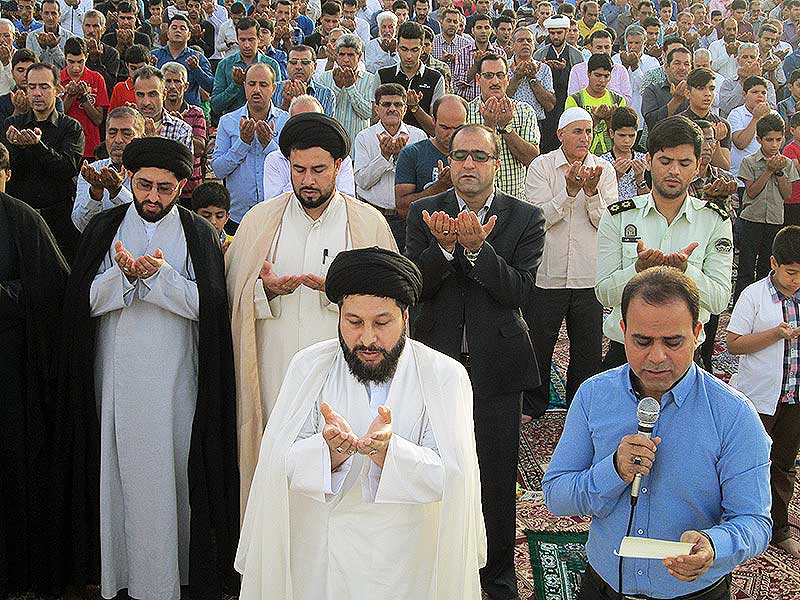
Rules Concerning Eid al-Fitr and Eid al-Adhã Prayers

Question 143: Why is the Eid prayer led by one person and the Eid qunut dua led by another person?

Answer 143: The Prayers for Eid al-Fitr and Eid al-Adha are obligatory during the presence of the Imam, Peace be upon him, and when he has complete freedom of action as well as the fulfillment of other required conditions, but they are approved during the Occultation (Ghaibat) of the Imam, and it is more cautious to offer them individually during the Period of Occultation of the Imam. There is, however, no objection in offering them with Jamã’at with the hope (that it shall be desirable to Allah), and not with intention that it has come down in the Shari’at The time for offering these two prayers is from the rising of the sun to noon. It does not become due if not offered.

They consist of two Rak’ats, in each of the Rak’ats one must recite the Sürat al-Hamd (Chapter 1 of the Quran) and some other Surah of the Quran. It is, however, preferable to recite Surat al-Shams (Chapter 91 of the Quran) in the first Rak’at and Surat aI-Ghãshiyah (Chapter 88 of the Quran) in the second Rak’at, or Surat al-A’la (Chapter 87 of the Quran) in the first Rak’at and Surat al-Shams in the second Rakat. After the recitation of the Surah from the Quran in the first Rak’at, one must recite five Takbirs and five Qunuts, one Qunut being after each Takbir, and in the second Rak’at four Takbirs and four Qunuts, one Qunut being after each Takbir.

In the Qunüt, it is permissible to recite any Dhikr or Du’ã’ like other prayers, and if one recites what is usual, there is no harm; rather, it would be approved, and that is as follows (in Arabic): “Allãhummã ahlal kibriyã’i val ‘azamati va ahlal judi val jabarut va ahlal ‘afwi var rahmah va ahlat taqwâ val maghfirah As’aluka bihaqqi hadhal yowmi ladhi ja ‘altahu lil Musilmeena Eidä va lil Muhammadin sallallãhu alaihi va àlihee dhukhran vasharafan va karãmatan va mazeeda an tusalli ‘alã Muhammadin va Al-i Muhammad va an tudkhilani fi kulli khairin adkhalta feehi Muhammadan va Al-a Muhammad va an tukhrijani min kulli su’in akhrajta minhu Muhammadan va Al-a Muhammad Salawàtuka ‘alaihi va ‘alaihim Allãhummã as’aluka khaira ma sa’laka bihi ‘ibãdukas Salihun va ‘audhu bika mimmasta’ãdha minhu ‘ibãdukal mukhlisun”.

Its English translation is as follows: “O Allah, Possessor of Majesty and Greatness, Possessor of Generosity and Almightiness, Possessor of Forgiveness and Mercy, Possessor of Protection and Pardon, I ask Thee, for the sake of this Day which Thou hast set for Muslims a Day of Rejoicing, and for Muhammad, Blessing be on him and his Progeny, (a source of) treasure, honour, dignity and even more, to send Blessing to Muhammad and his Progeny, and to enter me (or my name) in every good deed, Thou hast entered in it (the names of) Muhammad and Muhammad’s Progeny, and remove me (or my name) from every evil, Thou hast removed from it (the names of) Muhammad and Muhammad’s Progeny, Thy Blessing be on him and them. O Allah, I ask Thee for every good thing asked for by Thy pious Devotees, and seek of Thee for the refuge sought for by Thy pure Devotees.”

If a group of people offers these two prayers with Jamã’at with the intention of hope (that it would be desirable to Allah), the Imam shall deliver two Sermons after offering them with the intention of hope (that it would be desirable to Allah). It is permissible to give up both these prayers during the

Period of Occultation (of the Twelfth Imam). (When these prayers are offered), it is permissible to recite the words loudly by the Imam (when offered with Jamãat), or by the individual (when offered individually). It is also approved to raise the hands at the time of reciting the Takbirs, and offer it in large open spaces excepting Mecca. It is disapproved to offer these prayers under a roof.

Like all other Jama’ats, the Imam is not responsible in these prayers for anything except recitation.

If a person doubts about the number of the Takbirs or Qunuts (in these prayers), and the doubt occurs in its proper place (of compensation), he shall decide in favour of the minimum.

If a person does something entailing the performance of the prostration for error, it is more cautious to perform the prostration for error with the intention of hope (that it would be desirable to Allah), though its non-obligation, when the prayer be considered to be approved, (and not obligatory), is not devoid of force. The same is the case with the compensation for a forgotten Tashahhud or prostration

In the prayers for Eid al-Fitr and Eid al-Adhà, there is neither a call for prayer (Adhãn), nor a call for standing for prayer (Iqamah). Of course, it is approved for the Muadhdhin (one who calls for prayer) to call (loudly) three times: ‘Assalat’ (i.e., The prayer is ready).[1]

According to an obligatory precaution, it is said that two sermons (khutbas) be delivered after Eid prayer (in regards to the Jummah prayer, another difference is that the khutbah is delivered before prayer and with Eid prayer the khutbah is delivered after the prayer), and it is better the sermons should explain rules regarding Zakatul Fitr.

– If you are going to offer it individually, you must recite the whole Dhikrs by yourself.

– If you want to offer it in congregation, some of its Dhikrs are recited by the Imam and others by you and the Imam simultaneously.

– When the Imam of prayer is reciting Surah al-Hamd and al-Ikhlas (or al-A’la) others just listen and don’t recite these Surahs by themselves.

– Other Dhikrs such as Takbirs, dua in Qunut, Ruku, Sujood and Tashahhod are being recited by the Imam of Prayer and all Mamomeen altogether.

– Since this prayer comes only once a year, there is often difficulties about how to offer this prayer and recite the dua in Qunut. So, a mukabbir (one who pronounces takbir) is usually recite this dua in order to help others recite this dua correctly. However, the Imam of prayer and all Mamoneen are reciting it by themselves.[2]

For further information in this regards, please refer to the following answer:

Index: Zakat of Fitrah, Zakãt al-Abdan (or Zakãt of Bodies), answer 045.

Index: Zakat and difference between Sayyid and non-Sayyid holms, answer 040.

[1] . Tahrir al-Wasiah of Imam Khomeini, Vol. 1, Rules Concerning Eid al-Fitr and Eid al-Adhã Prayers.

[2] . Tawzih al-Masail (without annotation), Roohollah al-Moosavi al-Khomeini, Vol. 1, Pgs. 824 & 825 question 1516, 1519 & 1520.

post

Reciting Dua or Dikr in any language during the Prayer

Question 579: Hi. I have heard that Muslim can make Dua during Sajdah in his own language while praying. Is this true?

In which position that Dua would be recited. Will it be while saying Subhana rabbi al awla in Sajdah?

Answer 579: The followings are the answers of our maraja’ regarding this issue:

Imam Khomeini (ra), Ayatollah Araki (ra) Ayatollah Noori Hamedani:

There would be no problem to recite dua in any language other than Arabic while praying.[1]

Ayatollah Bahjat (ra):

Reciting dua or dikr in any language which is specialized for the person offering prayer is permissible, though it is against the precaution.[2]

Ayatollah Tabrizi (ra), Khoei, Shobairi Zanjani, Safi, Golpayegani and Vahid Khorasani:

There would be no problem to recite dua while praying, however you are supposed not to recite it in other than Arabic langage, according to a recommended precaution.[3]

Ayatollah Khamenei:

There is no problem to recite dua in any language during the prayer.[4]

Ayatollah Sistani:

Reciting Dua during the prayers is permissible. However, the recommended precaution is that one should not read Duas in any language other than Arabic.[5]

Ayatollah Fazel Lankarani (ra):

Reciting dua during the prayer is permissible, however it should be recited in Atabic language, according to an obligatory precaution.[6]

Ayatollah Makarem:

It is impermissible to recite dua in any language other than Arabic.[7]

Note: It is obligatory to recite Dhikr in prostration as mentioned under Rukü’, the major Tasbih here being: Subhana rabbiyal a’lã va bi hamdihi.[8]

It is mustahab to recite dua in the last sajdah of the prayer. In this regards, Imam Ali (as) says: It is not necessary to recite Surah al-Hamd and Ikhlas in Ruku and Sajdah. You are recommended to at first praise Allah, the Almighty and then make dua.[9]

The followings are duas we are recommended to recite. Although, they haven’t exactly mentioned in traditions, but there are some traditions that are related to these duas.

. Ya Latif irham ‘abdika al dhaeef al-Zaleel.[10]

. Ya Wali ul Aafeeya, As’aluka al-Afyiah, Aafyit al-Dunya wal Akhirah.[11]

For further information in this regards, please read the following answer:

Index: Number of things which invalidate the prayer.

Index:  Perform our prayers in Arabic language, answer 010.

[1] . Tawzih al-Masael, Pg. 154, q. 1135; ibid, Pg. 207, q. 1137; Ibid, Pg. 231, issue. 1136.

[2] . Istiftaat, Vol. 2, Pg. 151, q. 2029.

[3] . Tawzih al-Masael, Pg. 176, q. 1144; Ibid, Pg. 197, issue. 1144; Ibid, Vol. 1, Pg. 270, issue. 1144; Ibid, Pg. 229, issue. 1144; Ibid, Pg. 199, issue. 1144; Ibid, Pg. 408, issue. 1144.

[4] . New Istiftaat, N. 1, Pg. 16, code: 32304.

[5] . Tawzih al-Masael of Maraja, Pg. 232, issue. 1122; The official website of the office of Sayyid Sistani, rules concerning Things which invalidate prayers » Introduction.

[6] . Tawzih al-Masael, Pg. 192, issue. 1154.

[7] . Tawzih al-Masael, Pg. 193, issue. 1016.

[8] . Tahrir al-Wasilah of Imam Khomeini, Vol. 1, Rules Concerning Sajdah (Prostration).

[9] . Wasael al-Shia, Vol. 6, Pg. 310.

[10] . Sheikh Sadouq, Man la Yahduruhul Faqih, researcher and editor: Ghafari, Ali Akbar, Vol. 2, Pg. 165; Sayyid bin Tawus, Radi al-Din Ali, al-Iqbal bil Aamal al-Hasanah, researcher and editor: Qayoumi Esfahani, Javad, Vol. 1, Pg. 395.

[11] . Sheikh Sadouq, Oyoun Akhbar al-Rida (as), researcher and editor: Lajvardi, Mahdi, Vol. 2, Pg. 16; al-Iqbal bil Aamal al-Hasanah, Vol. 3, Pg. 39.

post

Ruling on foods and drinks containing alcohol / Vanilla Extract

Question 578: Salaam, I would like to ask regarding the alcohol contain in vanilla essence or medicine. I read once that the pharmacy alcohol is Pak. So it is safe to use vanilla essence or medicine with pharmaceutical alcohol, right? Please confirm. Jazakallah khair

Answer 578: A similar question has sent to the office of grand jurists and the answers that have been received are as follows:

Ayatollah Khamenei:

Generally speaking, the alcohol which is not determined whether or not it is originally intoxicating or not, is ritually clean and is treated as such. There is no problem in using the liquids which contain alcohol and if one doubts whether the alcohol is intoxicating or not, it is treated as clean. So, if the alcohol is not intoxicating and it is not in a liquid form either, it is halal.[1]

Ayatollah Sistani:

All kinds of alcohol whether derived from wood or other sources are pure (tãhir). Therefore, the food in whose preparation alcohol was used is tãhir except for when it causes drunkenness, in which case, the ruling which will apply to it would be different; it would be haram to use it. God knows best.

Considering that vanilla extract contains 35% alcohol, it is not permissible to use its extract![2] But, if the alcohol used in it is so minute that it dissolves in it, there would be no problem to use it.[3]

Q: Alcohol is used in the production of many drugs and medications: Is it permissible to take them? Are they considered pure (tãhir)?

A: They are pure; and since the alcohol used in them is so minute that it dissolves in them, it is therefore permissible to take them also.[4]

Ayatollah Makarem Shirazi:

Considering the high quantity of alcohol in it, it is necessary to avoid it.

Alcohols are divided into two groups: Alcohol that is produced through chemical processes and the one produced through distillation and fermentation. Since ethanol is an industrial alcohol, we will take a look at some facts about industrial alcohol:

The truth of the matter is that industrial alcohol shares the same formula fermented alcohol has (C2H5OH). The difference between the two though, is that industrial alcohol isn’t considered khamr, while distilled alcohol, since it comes from the distillation of khamr, might be considered khamr itself.

The common viewpoint among the ulema is that any intoxicating substance that is originally liquid is najis. The question is, does industrial alcohol fall under this category or not?

According to the common viewpoint here, it seems that industrial alcohol can’t be considered an intoxicant although it is used in intoxicating drinks. The reason that it isn’t considered an intoxicant isn’t that they add poisonous and foul-smelling substances such as methanol to it, but because it is so dense and concentrated that if no additives are added to it, drinking even a little is poisonous, this is why this substance (industrial alcohol) isn’t considered as an intoxicant by the people (urf).[5]

Other Translation:

نمایه: حکم ترکیبات الکل یا ژلاتین در مواد غذایی، سوال شماره 32.

[1] . Tawdzīh al-Masā’il of Marāja‘, Vol.1, Pg.145; Istiftā’āt by Ayatollah Khamenei, q.  302,304,305,306,307(Published by Jameh Mudarrasin).

[2] . For further information in this regards, please refer to IslamQuest Website.

[3] .  The official website of the office of Sayyid Sistani (ha), Question & Answer » Eating & Drinking.

[4] . Ibid.

[5] The Hawza website, the page of the E-library on Alcohol and its products.